

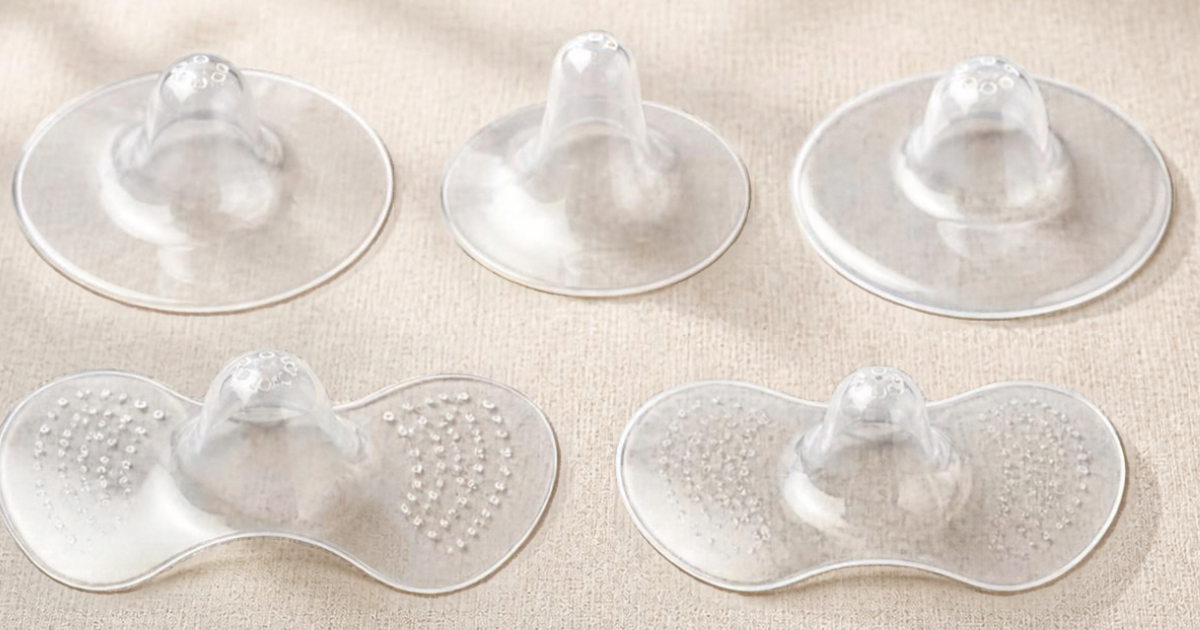
Breastfeeding Tips: 🤱 Nipple Shields: Helpful Tool or Unnecessary Hurdle?
A nipple shield can be a wonderful breastfeeding tool, but it isn’t meant to be the automatic answer when a baby has difficulty latching. Are they actually a helpful tool or an unnecessary fix that you need to fight to get off of? Let’s talk about it.
A nipple shield is a thin silicone device that fits over the nipple and areola. It can sometimes help a baby who is having difficulty maintaining a latch, especially when there are challenges such as a premature or sleepy baby, a baby with a weak or uncoordinated suck, very flat or inverted nipples, significant nipple pain, or a baby who has become accustomed to a bottle.
But here’s something I want every new parent to know: being offered a nipple shield after one unsuccessful attempt at breastfeeding does not necessarily mean you need one.
Those first few hours after birth can be challenging. Your baby is learning how to breastfeed, and you are learning how to breastfeed your baby. One difficult latch doesn’t tell us very much about what will happen at the next feeding.
Before reaching for a shield, I’d rather see someone take a little time to figure out why the latch isn’t working.
Is baby positioned well?
Is baby sleepy?
Is there a lot of breast fullness or swelling?
Does baby have a wide gape?
Is the nipple entering baby’s mouth deeply enough?
Is there something about baby’s oral anatomy or sucking pattern that is making latching difficult?
Sometimes a small adjustment in positioning or latch is all that is needed.
So, are nipple shields bad?
Absolutely not.
There are times when a nipple shield can be exactly the right tool. It may help a baby stay at the breast while you work on the underlying issue. For some families, it can be the bridge that helps them establish breastfeeding.
The important thing is that someone should help you understand why you’re using it, how to use it correctly, and what the plan is for eventually reassessing it.
A shield can also affect milk transfer for some babies, so monitoring baby’s feeding, diaper output, and weight is important. Depending on the situation, pumping or hand expression may also be recommended to protect milk production while baby is learning to breastfeed effectively.
One hard latch doesn’t equal a breastfeeding problem.
This is the part I really want new parents to remember.
Your first breastfeeding attempt is not a test you can pass or fail.
Birth is a huge transition for both of you. Sometimes baby needs a little time. Sometimes you need a little time. And sometimes there really is a problem that needs some extra help.
A nipple shield can be part of that help. But ideally, it should be a tool chosen because it addresses a specific need, not simply because breastfeeding didn’t work on the first try.
And if you were handed a nipple shield in the hospital and sent home wondering, “Do I actually need this?” you’re not alone. That’s exactly the kind of question a lactation consultant can help you sort out.
Patrice’s Pearl: Don’t judge your breastfeeding journey by the first latch. One feeding is a moment in time, not a prediction of how breastfeeding will go.
P.S. A colleague, Susan Howard, IBCLC in the DC area has a wonderful “tip” about how to help nipple shields stay intact Try using the silver cups anti-slip adhesive that you can buy to help keep your silverettes in place.
